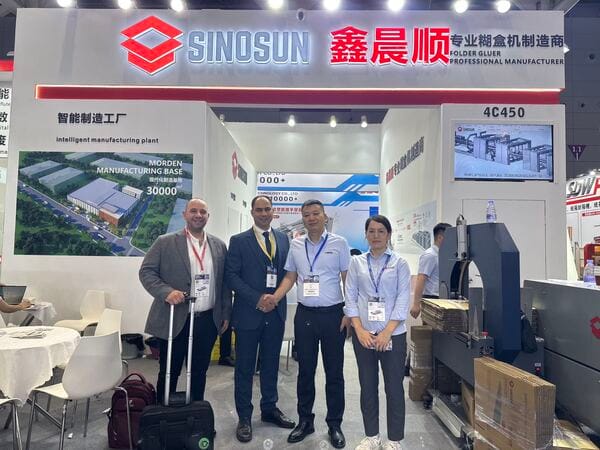
Sourcing packaging equipment from China offers compelling cost advantages, but how do you separate professional manufacturers from resellers operating out of rented warehouses? The wrong choice doesn’t just delay your project—it can strand you with unsupported equipment thousands of miles from the supplier.
An automatic folder gluer factory is a specialized manufacturing facility that designs, assembles, and tests folder gluer machines, typically occupying 10,000+ square meters with dedicated production zones, quality control systems, and after-sales service infrastructure. Reliable factories in China’s packaging machinery sector hold valid CE certification, maintain patent portfolios exceeding 30 active registrations, and operate global service networks covering major export markets.
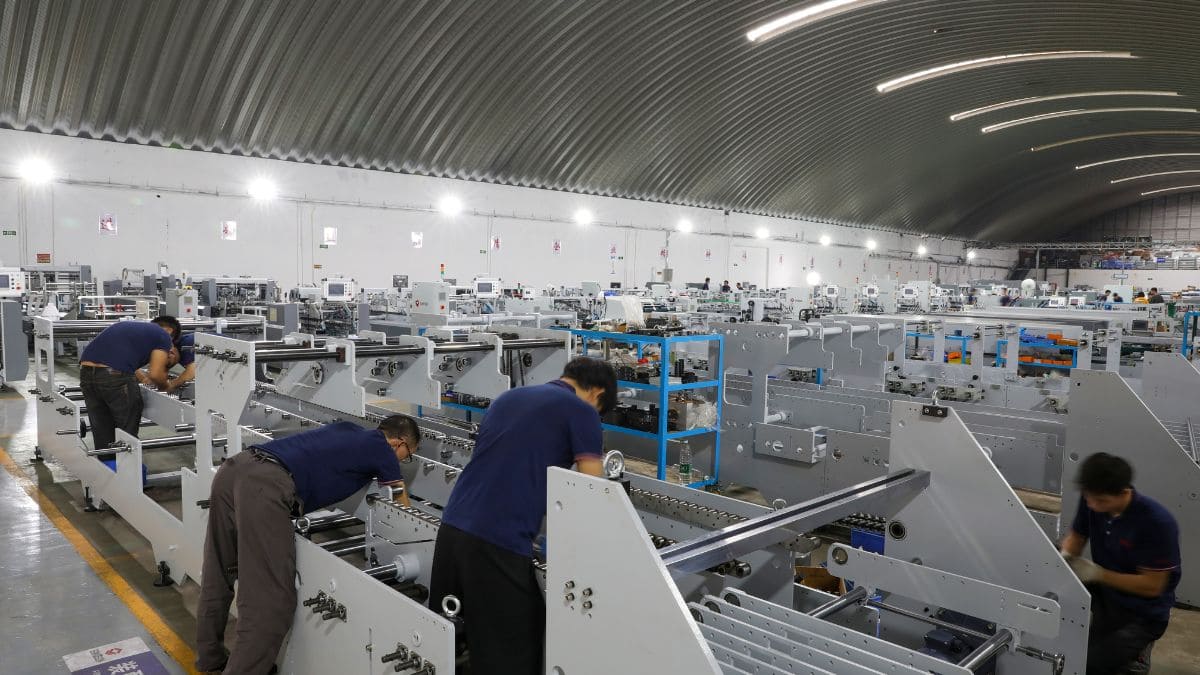
Why does factory evaluation matter more than product specifications? Because a technically impressive machine from an under-resourced supplier becomes a liability the moment you need spare parts, technical support, or warranty service. Smart procurement managers evaluate the factory first, then assess the equipment.
How Large Should an Automatic Folder Gluer Factory Be?
When I first started evaluating Chinese suppliers, I made a rookie mistake—I focused entirely on product catalogs and ignored facility scale. That oversight cost my client three months of delays when the "manufacturer" turned out to be a trading company outsourcing production. Factory size isn’t vanity; it’s a proxy for production capacity, financial stability, and long-term viability.
Factory floor area serves as a primary indicator of manufacturing capability, with professional automatic folder gluer manufacturers typically operating facilities of 10,000 square meters or larger to accommodate assembly lines, component storage, testing zones, and quality inspection areas required for consistent production output.
Understanding the relationship between facility size and production reliability helps you filter out resellers and focus on genuine manufacturers. But raw square footage alone doesn’t tell the whole story—you need to evaluate how that space is organized and utilized.
Minimum Recommended Factory Floor Area
What constitutes adequate manufacturing space for a credible folder gluer supplier? Industry benchmarks provide clear guidance:
- Factories with at least 10,000 square meters typically demonstrate sufficient space for organized production lines, raw material storage, and finished goods inventory—smaller facilities often indicate assembly-only operations or trading companies rather than integrated manufacturers.
- Larger facilities above 15,000–20,000 square meters allow dedicated zones for assembly, testing, and quality inspection without congestion, enabling simultaneous production of multiple machine models and reducing lead times from 45-60 days to 30-40 days for standard configurations.
- Buyers should request official floor plans or satellite images to verify actual usable production space versus office or warehouse areas—some suppliers inflate facility size by including leased warehouses or shared industrial park common areas that don’t contribute to manufacturing capacity.
Indicators of Production Capacity from Facility Size
How does floor area translate into real-world production capability? Look for these operational indicators during factory visits:
- Adequate floor area supports multiple simultaneous assembly lines and reduces lead times for large orders—a 30,000㎡ facility like Sinosun’s can typically maintain 3-5 parallel assembly stations, enabling monthly output of 15-20 complete folder gluer systems depending on model complexity.
- Well-planned layouts with clear material flow paths indicate professional management and lower risk of production bottlenecks—observe whether raw materials enter from one side, progress through sequential assembly zones, and exit as tested finished goods from the opposite end without backtracking or congestion.
- On-site verification visits should include checks for modern infrastructure such as high ceilings (minimum 6-8 meters for overhead crane operations), reinforced floors rated for heavy machinery movement, and climate-controlled sections for precision assembly and electronics integration—these features separate serious manufacturers from basic assembly workshops.
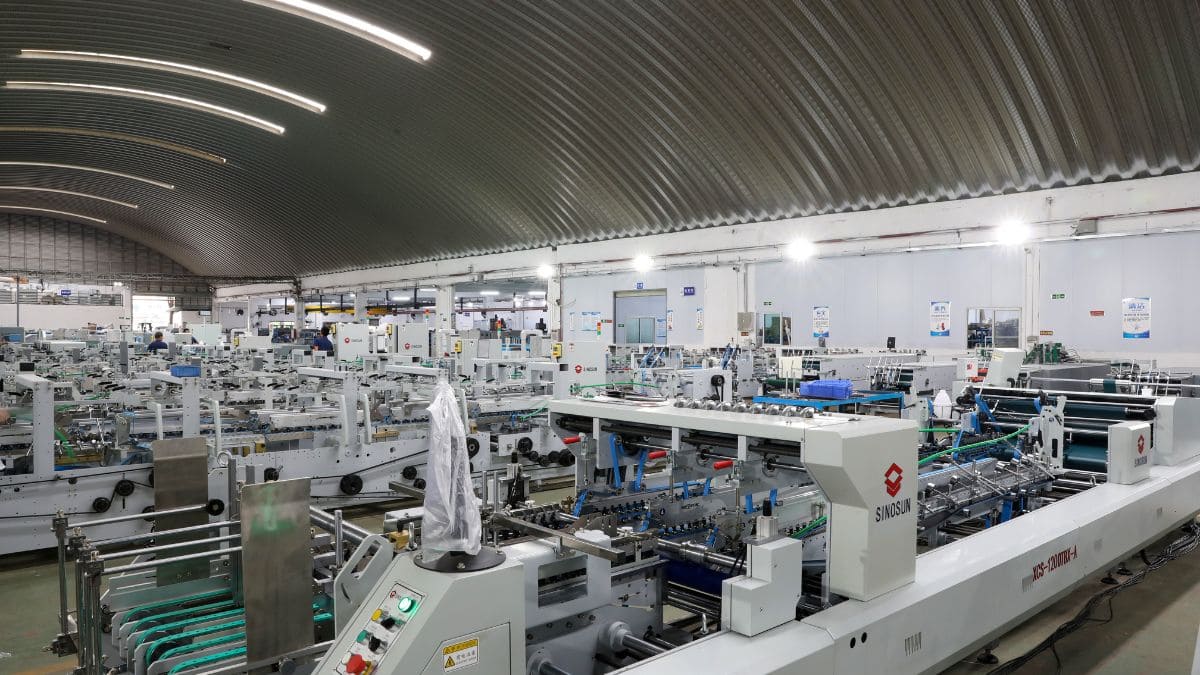
Factory scale assessment isn’t about demanding the largest facility—it’s about ensuring the supplier has adequate resources to fulfill your order, maintain quality standards, and remain operational for long-term support. A well-organized 12,000㎡ factory often outperforms a chaotic 25,000㎡ facility.
Why Do CE Certification and Patent Counts Matter?
Here’s what surprised me most about Chinese packaging machinery suppliers: the quality gap between certified and uncertified factories is far wider than the price difference suggests. I’ve seen buyers save 15% by choosing a non-CE supplier, only to face 30-40% cost overruns dealing with customs rejections, safety compliance retrofits, and liability insurance complications. Certifications and patents aren’t bureaucratic paperwork—they’re risk mitigation tools.
CE certification and patent portfolios serve as objective indicators of factory quality compliance and innovation capability, with certified manufacturers demonstrating adherence to European safety standards while patent holdings reveal ongoing R&D investment and technical differentiation from commodity suppliers.
These credentials function as pre-qualification filters that eliminate high-risk suppliers before you invest time in detailed technical evaluations. But not all certifications and patents carry equal weight—you need to verify authenticity and relevance.
Importance of CE Certification for Export Compliance
Why does CE certification matter if you’re not shipping to Europe? Because it sets a baseline for machinery safety and quality that protects you regardless of destination market:
- Valid CE certificates confirm the factory meets European machinery safety and electromagnetic compatibility standards required for EU market entry, covering critical aspects like emergency stop systems, electrical insulation, noise emissions, and operator protection—standards that also reduce workplace accident liability in non-EU markets.
- Buyers should request the latest certificate copies along with test reports from accredited European notified bodies (look for organizations like TÜV, SGS, or Bureau Veritas), not just self-declared CE marks that lack third-party verification and offer no legal protection.
- Absence of current CE certification increases customs clearance risks and potential legal liabilities for importers—EU customs can detain non-compliant machinery indefinitely, while workplace accidents involving uncertified equipment may void insurance coverage and expose buyers to regulatory penalties.
Evaluating Patent Quantity and Quality
How many patents should a credible folder gluer manufacturer hold? Industry leaders typically maintain substantial portfolios:
- A portfolio of 30 or more invention and utility patents signals ongoing R&D investment and technical differentiation—Sinosun, for example, holds over 50 patents covering structural innovations, control systems, and safety mechanisms that distinguish their equipment from generic designs.
- Focus on patents related to structural design, control systems, and safety features rather than generic claims—examine whether patents cover core technologies like servo synchronization methods, inline inspection algorithms, or unique folding mechanisms, not just cosmetic design variations.
- Cross-check patent numbers on official databases such as CNIPA (China National Intellectual Property Administration) or Espacenet to confirm ownership and validity dates—this simple verification step exposes suppliers who list expired patents, patents owned by other companies, or fabricated registration numbers.
Combining Certifications and Patents for Risk Reduction
What’s the synergy between certifications and intellectual property? Together, they create a comprehensive quality profile:
- Factories holding both CE certification and multiple patents demonstrate commitment to international standards and continuous improvement—this combination indicates a manufacturer investing in both compliance infrastructure and technical innovation rather than competing solely on price.
- These credentials reduce the likelihood of quality disputes and support smoother long-term business relationships—certified, patent-holding suppliers typically maintain formal quality management systems, documented testing procedures, and traceable component sourcing that prevent the "specification drift" common with uncertified manufacturers.
- Request a summary document listing all current certifications and active patents during initial supplier screening—professional manufacturers maintain organized credential portfolios and provide this information readily, while evasive responses or delays often signal credential gaps or authenticity issues.
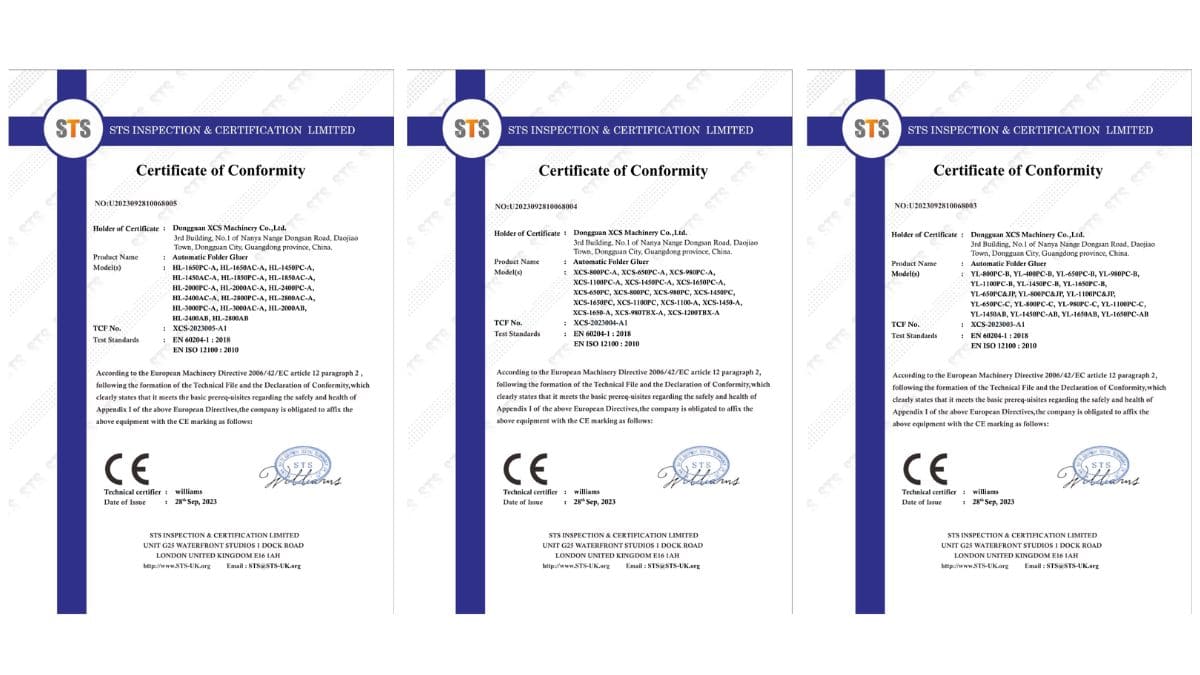
Credential verification takes minimal time but eliminates maximum risk. Spend two hours validating certificates and patents before investing weeks in technical negotiations with a supplier who can’t legally ship to your market or defend their technology claims.
How Strong Is the Factory’s After-Sales Network?
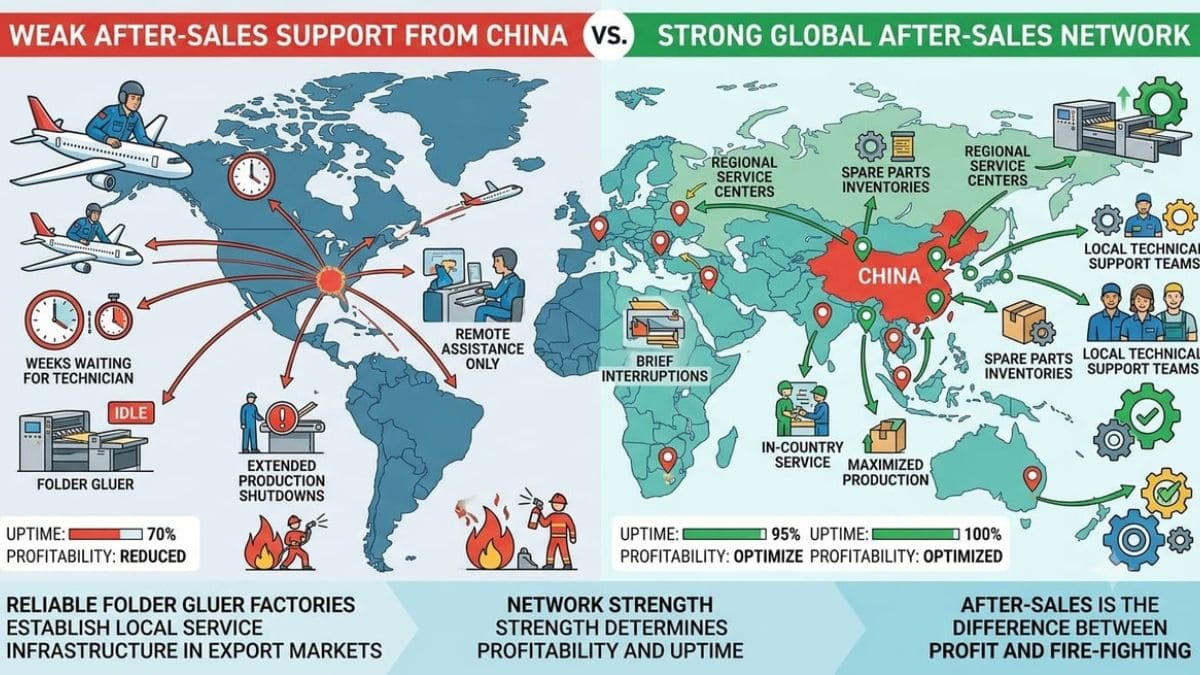
To be honest, this is where most China sourcing decisions go wrong. Buyers obsess over purchase price and delivery time, then discover their "bargain" folder gluer sits idle for weeks waiting for a technician to fly in from Guangdong. After-sales capability isn’t a nice-to-have feature—it’s the difference between 95% uptime and 70% uptime, between profitable production and constant firefighting.
After-sales network strength determines whether equipment problems cause brief interruptions or extended production shutdowns, with reliable automatic folder gluer factories maintaining regional service centers, spare parts inventories, and technical support teams in major export markets rather than relying solely on remote assistance from China.
The best time to evaluate after-sales capability is before you sign the purchase order, not after your machine breaks down. Ask detailed questions and demand verifiable proof of service infrastructure.
Geographic Coverage of Service Centers
Where should your supplier maintain physical service presence? Coverage requirements depend on your location and production criticality:
- Reliable factories maintain service teams or authorized partners in major export markets including Europe, North America, and Southeast Asia—this local presence enables 24-48 hour on-site response for critical issues versus 7-14 day delays waiting for technicians to obtain visas and travel from China.
- Ask for a current service network map and contact details of regional engineers who can provide on-site support—test these contacts by calling them directly to verify they’re actual service personnel, not just sales representatives who forward technical questions back to the factory.
- Limited or no overseas presence increases downtime risks when technical issues arise after installation—remote troubleshooting via video calls works for simple problems but fails for mechanical adjustments, electrical diagnostics, or component replacements requiring hands-on intervention.
Response Time and Spare Parts Availability Commitments
What service level agreements should you expect from a professional supplier? Concrete commitments matter more than vague promises:
- Professional suppliers publish clear service level agreements specifying maximum response times for remote and on-site support—look for commitments like "4-hour remote response, 48-hour on-site arrival for critical failures" rather than generic statements about "prompt service."
- Confirm that critical spare parts are stocked in regional warehouses to minimize production interruptions—components like glue pump seals, vacuum cups, sensors, and drive belts should be available for next-day delivery, not requiring 2-3 week shipments from China that halt production.
- Request references from existing international customers regarding actual service experience and resolution speed—speak directly with operations managers at 2-3 current users in your region to verify whether the supplier’s service claims match real-world performance.
Training and Remote Support Capabilities
How does the factory enable your team to handle routine issues independently? Comprehensive training reduces service dependency:
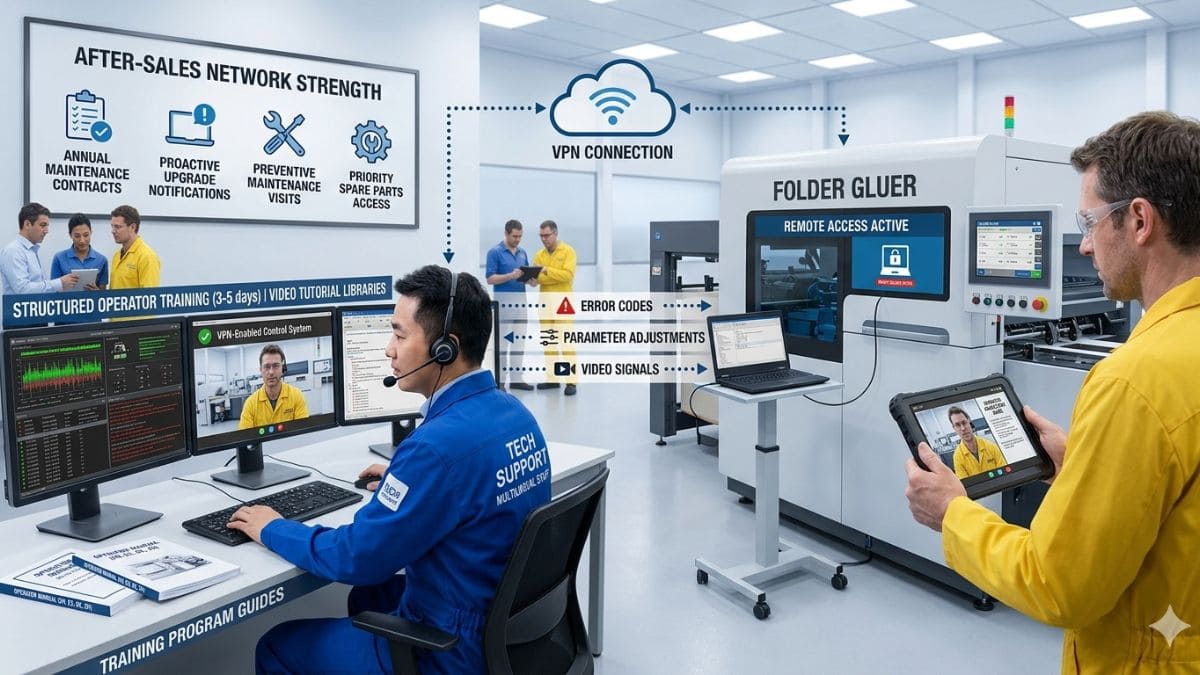
- Factories offering structured operator training programs and multilingual documentation reduce dependency on frequent site visits—look for suppliers providing 3-5 day on-site training during installation, video tutorial libraries, and operator manuals translated into your local language by native speakers, not machine translation.
- Modern remote diagnostic tools allow engineers to troubleshoot issues without physical presence in many cases—advanced suppliers equip machines with VPN-enabled control systems that let technicians remotely access machine parameters, review error logs, and guide local operators through adjustments via video call.
- Strong after-sales networks typically include annual maintenance contracts and proactive upgrade notifications—these programs schedule preventive maintenance visits, provide priority spare parts access, and alert you to software updates or safety bulletins before problems occur rather than reacting to failures.
After-sales evaluation should include a test scenario: "If my glue application system fails on a Friday afternoon, walk me through exactly what happens in the first 24 hours." The supplier’s response—specific names, phone numbers, parts locations, and response procedures—reveals whether they have real infrastructure or just good intentions.
Conclusion
A reliable automatic folder gluer factory in China can be identified by evaluating four critical dimensions: facility scale of 10,000+ square meters, valid CE certification with 30+ active patents, and comprehensive after-sales networks covering your target markets. Sinosun operates a 20,000㎡ facility, holds over 50 patents and CE certification, and maintains global service infrastructure to support international customers. Before initiating supplier negotiations, create a structured factory evaluation checklist covering floor area verification, credential authentication, and service capability testing—then contact our team for a facility tour or explore our certified product range designed for reliable long-term operation.